How Long Does Ashwagandha Take to Work?
Research timelines vary by extract, serving, goal, and person. Here is the honest way to think about study length, personal response, and your next safe step.
THE SHORT ANSWER
There is no guaranteed ashwagandha timeline.
Some human studies have measured outcomes after several weeks, but the timing is not a promise for every person or every product. Studies use different extracts, serving sizes, participants, and outcomes. A study period tells you how the study was designed, not exactly when you will notice a change. [1]
The most accurate answer is: it depends on the preparation, the outcome being measured, the length of the study, and the individual.
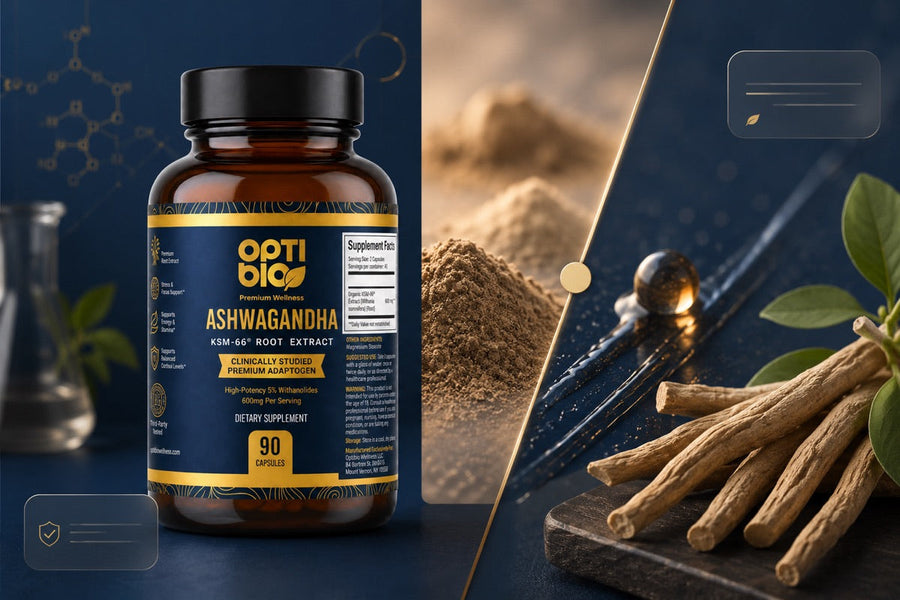
Optibio’s current product directions say to take two capsules daily, ideally with a meal, providing 600 mg of KSM-66® Ashwagandha root extract per serving. Follow the label rather than increasing the amount because you do not notice an immediate change. For how that serving is structured across a 45 day supply, see our ashwagandha dosage guide. [2]
WHY IT VARIES
Ashwagandha is not one identical product.
Products can differ in plant part, extract identity, extraction method, standardization, serving size, and capsule formula. The NIH Office of Dietary Supplements notes that human studies have used different root extracts, root and leaf extracts, and whole root preparations. Extract quality is a large part of why two labels at the same milligram count are not the same, which we break down in KSM-66 vs regular ashwagandha. [3]
| Study detail | Why it matters |
|---|---|
| Preparation | Root and root and leaf products may not be interchangeable. |
| Dose and standardization | Milligrams alone do not describe the complete extract. |
| Study length | A study period is not a personal results promise. |
| Outcome | Sleep, stress, fatigue, and other measures need separate interpretation. |
READ THE STUDY, NOT JUST THE HEADLINE
What do researchers actually measure?
A study may measure a questionnaire score, sleep quality, sleep latency, cortisol, fatigue, or another endpoint. These are not interchangeable. A change in one measure does not prove a broad effect across every part of life.
A useful four question check
What product was used? What amount was studied? How long did the study last? What exact outcome was measured?
NCCIH says many ashwagandha studies have been small and have used a variety of preparations. It notes that research has looked at some preparations for stress and sleep, while evidence for several other uses remains unclear. [1]
SLEEP RESEARCH
What does the sleep research show?
Ashwagandha is commonly used to support healthy sleep quality. The research that exists has used specific extracts at defined servings over several weeks, and results have varied between studies and between people. More safety information is still needed, especially for long term use.
None of that sets a timeline for Optibio or for any individual. How long a study ran describes how it was designed, not when you will notice a change.
For a plain language discussion of taking it in the morning or at night, read Ashwagandha Morning or Night?. If you are choosing an evening product specifically, our guide to the best ashwagandha for sleep covers what to look for.
STRESS RESEARCH
What about stress?
The NIH Office of Dietary Supplements describes stress studies lasting roughly six to eight weeks, with doses and preparations that varied. Several studies used approximately 500 to 600 mg per day, but the products were not identical. [3]
A responsible article can say that stress outcomes have been studied over several weeks. It should not say that Optibio will reduce stress by a specific date, that a customer will feel calmer within a fixed period, or that a particular dose guarantees a result.
The same caution applies to focus, mood, energy, recovery, and resilience. These are useful goal page themes, but they should not be paired with guaranteed day or week timelines without product specific evidence and approval.
A SIMPLE, SAFE ROUTINE
What should you do while you wait?
If you choose to use a supplement, a short record can help you discuss your experience with a professional. Note the product, labeled serving, time taken, other supplements and medicines, sleep routine, and any symptoms or changes you notice.
Keep the record descriptive, not diagnostic. A personal observation does not prove that a supplement caused a change.
| Write down | Avoid assuming |
|---|---|
| When you took the labeled serving | That a faster response means a better response. |
| Other medicines and supplements | That a lack of quick change means you should take more. |
| Symptoms or changes | That every change was caused by ashwagandha. |
| Questions for a pharmacist or clinician | That an online timeline can diagnose a health condition. |
If you do not notice anything, review the label and ask a qualified healthcare professional before changing the amount. Do not take extra capsules or combine multiple ashwagandha products to try to speed up an outcome.
A QUICK SAFETY CHECK
Timing and safety are separate questions.
What side effects have been reported?
NCCIH and the NIH Office of Dietary Supplements identify possible side effects such as drowsiness, stomach upset, nausea, loose stools, diarrhea, and vomiting. Rare reports have also linked ashwagandha supplements with liver injury. [1]
When should I stop and seek help?
Stop and seek medical advice if symptoms are severe, persistent, or concerning. Seek urgent care for trouble breathing, swelling of the face or throat, fainting, confusion, severe abdominal pain, or yellowing of the skin or eyes.
Who should ask a professional before use?
Ask before use if you are pregnant or breastfeeding, have thyroid, autoimmune, liver, or hormone sensitive concerns, have surgery planned, take prescription medicines, are considering use for a child or teenager, or have persistent or worsening symptoms. Possible interaction categories include diabetes and blood pressure medicines, immunosuppressants, sedatives, seizure medicines, and thyroid hormone medicines. For a fuller walk through of daily use and who should check first, read can you take ashwagandha every day. [1]
Does a longer timeline mean it is safer?
No. Duration and safety are separate questions. NCCIH says short term safety is better characterized than long term safety and that there is not enough information to draw conclusions about long term safety.
QUICK ANSWERS
Common questions about ashwagandha timing
Will I feel ashwagandha immediately?
There is no reliable universal answer. Some people may notice a subjective response sooner than others, while some may notice no change. Research timelines vary by preparation, dose, outcome, and study design.
How many weeks does ashwagandha take to work?
Some studies have measured outcomes over several weeks, including six to twelve weeks in sleep research. Those study periods are not personal guarantees.
Does ashwagandha work faster for stress than for sleep?
The evidence does not support a universal comparison. Stress and sleep studies use different outcomes and preparations, so their timelines should not be ranked as a general rule.
Should I take more if I do not notice results?
No. Do not increase the labeled serving on your own. Ask a qualified healthcare professional before changing the amount or combining products.
Can I use a timeline to decide whether I have a health condition?
No. This article does not diagnose a condition. Persistent or severe symptoms should be discussed with a qualified healthcare professional.
References
†These statements have not been evaluated by the Food and Drug Administration. This product is not intended to diagnose, treat, cure, or prevent any disease.