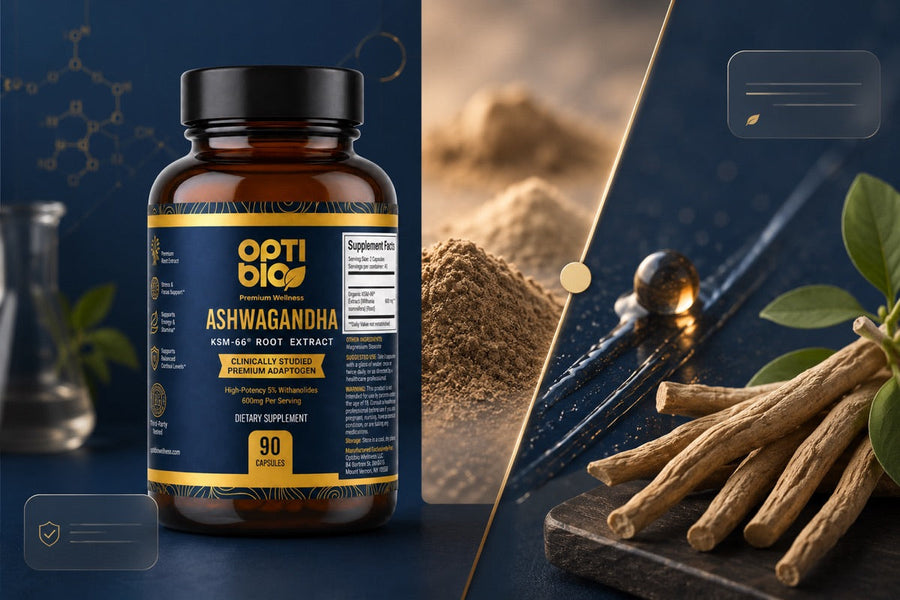
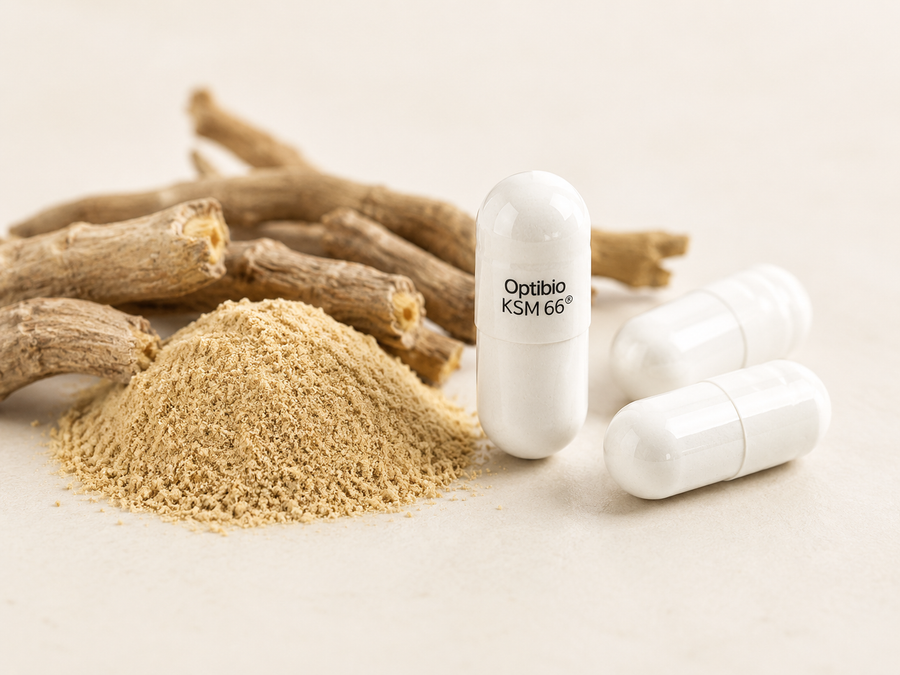
Optibio™ vs Transparent Labs Ashwagandha: An Honest 2026 Comparison
Both products use KSM-66® at 600mg/day. So what actually differentiates them? Side by side spec comparison, no marketing fluff.

Transparent Labs KSM-66® ashwagandha, reviewed
It is a good product, and on the active botanical there is nothing to separate them. Transparent Labs uses branded KSM-66® at a full 600 mg daily serving, standardized to 5% withanolides, third party tested. So does Optibio. If you are choosing between these two on what is inside the capsule, you are choosing between two versions of the same thing.
The differences are commercial, not chemical: the guarantee window, how many capsules come in a bottle, and whether you want a focused, science led line or a broad sports nutrition catalogue. Those are covered below.
Looking for Transparent Labs themselves? If you came here to buy from them or find their official site, go direct to transparentlabs.com. We are not going to waste your time pretending otherwise.
Quick answer: Both Optibio™ and Transparent Labs ashwagandha use KSM-66® at 600mg/day, the full dose. Spec parity is real. The differentiators are: (1) 90 day money back guarantee at Optibio, a longer window than Transparent Labs' 45 day satisfaction guarantee, (2) brand focus, Transparent Labs is broad sports nutrition; Optibio is a focused, science led brand built around full serving formulas. Read on for the full breakdown. Shop Optibio™ →†
If you’ve already done the homework on KSM-66® vs generic ashwagandha (different topic, covered in our extract guide), you’ve probably narrowed your shortlist to a few brands that all use the same patented extract at the same dose. At that point, comparison shopping is about everything except the active botanical.
This post compares Optibio™ against Transparent Labs head to head on the actual differentiating variables.
Side by side spec comparison
| Optibio™ | Transparent Labs | |
|---|---|---|
| Extract | KSM-66® | KSM-66® |
| Daily dose | 600mg (2 capsules daily) | 600mg (split 2 capsules) |
| Withanolide standardization | 5%+ (KSM-66® spec) | 5%+ (KSM-66® spec) |
| Capsules per bottle | 90 (45 day supply) | 60 servings |
| Third party tested | Yes | Yes |
| Manufactured in | GMP-certified facility | GMP-certified facility |
| Other ingredients | KSM-66® only as the active (vegetable cellulose capsule, magnesium stearate) | KSM-66® as the single active |
| Vegan / vegetarian | Vegetarian capsule | Check the current label |
| Money-back guarantee | 90 days | 45 days |
| Subscription discount | Yes: $24.99 for your first bottle (once per customer), then $36.99 every 45 days | Yes, flat % off |
| Brand focus | Focused, science led line of full serving formulas | Broad sports nutrition catalog |
Where they tie
- Active botanical: Both use the patented KSM-66® extract at the full 600mg/day serving
- Standardization: Both deliver the 5%+ withanolide standardization that defines the KSM-66® spec
- Manufacturing: Both manufactured in GMP-certified facilities
- Testing: Both publish third party test results
- Format: Both are single-active KSM-66® capsules, with no proprietary blends and no underdosed accessory ingredients
If you compare two products on these axes alone, you’d call it a tie. The differentiation is in the brand model and the post-purchase experience.
Where they differ
1. Money-back guarantee window
People often give an adaptogen 6 to 12 weeks before judging fit. Transparent Labs’ 45 day satisfaction guarantee is shorter than the 8 to 12 weeks people often give an adaptogen. Optibio’s 90 day window covers that full evaluation period; a 45 day window can end sooner.
If the supplement works the way people report, the difference doesn’t matter, you’ll keep buying it. If it doesn’t work for you specifically, you have a longer evaluation window with Optibio.
2. Brand focus
Transparent Labs is a broad-catalog sports-nutrition brand, protein, pre-workout, creatine, multi-ingredient blends, and ashwagandha as one of dozens of SKUs. Optibio is a focused, science led line, and its ashwagandha is the full serving KSM-66® protocol.
For some buyers, the broad-catalog brand is the appeal, one shipping address, multiple products. For others, a focused specialist is the appeal, a brand that puts its full attention on a small, carefully made line.
3. Subscription and pricing
Optibio is a single bottle at $49.99. On Subscribe and Save it is $24.99 for your first bottle, then $36.99 every 45 days until you cancel, with free shipping and cancel anytime. The $24.99 price is once per customer. Transparent Labs offers a flat percentage discount on single bottles. Which works out better depends on how long you intend to use the product.
Who should pick which
Pick Transparent Labs if…
You’re already buying their protein, pre-workout, or other products and want consolidated checkout. Convenience overrides marginal differences in guarantee window and pricing.
Pick Optibio™ if…
You want the longest evaluation window (90 days vs 45) for an ingredient many people evaluate over 8 or more weeks, and you prefer a focused specialist to a broad catalog.
Subscribe if…
You’re committed to running the full protocol (the routine runs 8 to 12 weeks). A subscription keeps you consistent: $24.99 for your first bottle, then $36.99 every 45 days until you cancel. The $24.99 price is once per customer.
Don’t pick either if…
You’re bargain-hunting on price alone, cheap generic ashwagandha exists. Just understand you’re trading evidence for cost. KSM-66® is the patented KSM-66 extract.
Nutricost vs Transparent Labs
A common shortlist pairs these two rather than either against us, so here is the straight answer.
Transparent Labs uses branded KSM-66®, a patented root only extract standardized to 5% withanolides, at a full 600 mg serving. Nutricost, in its standard ashwagandha, uses a generic root extract with no guaranteed withanolide percentage, at a much lower price.
That is the whole decision. You are choosing between a named extract with a published standardization figure, and a cheaper generic where batch to batch content can vary. Neither is a bad product. They are priced differently because they contain different things. Our fuller write up on the budget option is in the Nutricost review.
Third party testing, compared
Both brands state third party testing, which is the baseline you should expect from anyone selling a supplement. The useful question is not whether a brand says it tests, it is whether you can see the result.
- Ask for the certificate of analysis for your lot number, not a generic sample document. The lot is printed on the bottle.
- Check what was tested for. Potency alone is not enough. You want heavy metals, specifically lead, mercury, arsenic and cadmium, plus microbial screening.
- Check the date. A COA from two years ago tells you nothing about the bottle in your hand.
Optibio is third party tested, every batch. See our batch verification page. If a brand cannot produce a COA for your specific lot on request, that is the answer to your question.
Safety and who should check with a professional first
Ashwagandha is well tolerated by most healthy adults, but it is not right for everyone. Talk with a qualified healthcare professional before you start if any of the following apply to you.
- Thyroid conditions: Ashwagandha may influence thyroid hormone levels, so coordinate with your clinician if you have a thyroid disorder or take thyroid medication.
- Autoimmune conditions: If you live with an autoimmune condition such as lupus, rheumatoid arthritis or Hashimoto’s, check with your provider first.
- Pregnancy or breastfeeding: There is not enough evidence to consider it safe during pregnancy or while breastfeeding, so it is best avoided.
- Medication interactions: If you take sedatives, thyroid medication, immunosuppressants, or medication for blood pressure or blood sugar, review ashwagandha with your prescriber before starting.
For a fuller walkthrough, read our everyday ashwagandha safety guide.
Frequently asked questions
Are Optibio™ and Transparent Labs ashwagandha actually identical?
The active botanical is identical, both use the patented KSM-66® extract at the same 600mg dose. Capsule form and excipients vary slightly between manufacturers but neither uses anything controversial.
How long does each bottle last?
Optibio’s bottle holds 90 capsules, a 45 day supply at the 2 capsule daily serving. Transparent Labs lists 60 servings per bottle; check its current label for the exact capsule count. Both deliver the same 600mg daily total.
Can I switch between brands mid-protocol?
Yes, if both use KSM-66® at 600mg/day, switching mid-bottle doesn’t reset your timeline. The active botanical is the same.
Why does the guarantee window matter so much?
Because people commonly judge fit at 8 to 12 weeks. A 45 day window is shorter than the 8 to 12 weeks people often use to judge fit. A 90 day window aligns with the timeline people actually use.
Is Transparent Labs more “trusted” because it’s a bigger brand?
Both are manufactured in GMP-certified facilities and third party tested. Brand size doesn’t add evidence; the active botanical does. KSM-66® is the relevant trust marker, and both products use it.
The bottom line
Optibio™ vs Transparent Labs is a close comparison, both at full serving KSM-66®. The differentiators are guarantee window (Optibio’s 90 days vs Transparent Labs’ 45 days) and brand model (specialist vs broad catalog). Pick Optibio if you want the longer evaluation window and a focused specialist. Pick Transparent Labs if you’re already in their ecosystem.
See our complete 2026 ashwagandha buyer’s guide for the broader competitive landscape.
Shop Optibio Ashwagandha KSM-66® →
†These statements have not been evaluated by the Food and Drug Administration. This product is not intended to diagnose, treat, cure, or prevent any disease.